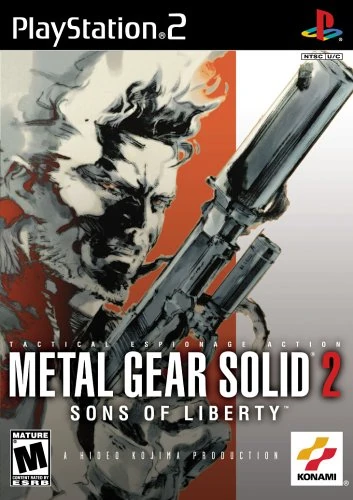



Metal Gear Solid 2 — postmodern espionage, systemic stealth, and the prophecy of information control
Presentation
Metal Gear Solid 2 exploded onto PS2 with cinematic ambition: letterboxed direction, long take cutscenes, and a tonal swing from techno‑thriller to meta‑satire that framed stealth as both choreography and commentary on player expectation. First‑person aiming and granular interactions—shooting radios to silence guards, targeting limbs and equipment, dangling from rails, hiding in lockers—made spaces feel toy‑box reactive rather than strictly scripted corridors. Its audio‑visual identity fused Hollywood‑grade sound with slick UI minimalism and Kojima’s dramatic framing, establishing a language that modern stealth action still borrows from two decades later.
Story
The prologue “Tanker” arc has Solid Snake infiltrate the Hudson River to capture proof of a new Metal Gear; an ambush by Revolver Ocelot leads to the war machine’s theft and a catastrophic sinking that frames Snake for eco‑terrorism. Two years later, the “Plant” chapter places rookie Raiden into Big Shell, a cleanup facility seized by terrorists called the Sons of Liberty—an operation entangling the enigmatic Dead Cell unit, the mercenary Olga Gurlukovich, and a figure claiming to be Solid Snake, all orbiting a deeper conspiracy. The twist reveals the S3 Plan—“Selection for Societal Sanity”—an AI‑driven memetic control system, with the Arsenal Gear fortress and the Patriots’ shadow network exposing a plot about censorship, manipulated context, and manufactured heroes that eerily anticipates social‑media‑era information wars.
Systems and structure
-
Stealth sandbox. Vision cones, noise propagation, and alert phases escalate from caution to full Evasion loops, while contextual tools—chaff, coolant spray, magazines as distractions—enable low‑lethality or ghost routes.
-
Precision and physics. First‑person targeting breaks the series wide open: disable a guard’s radio, shoot a helmet off, or shatter lights to carve darkness, each interaction rippling across patrol logic and alert timers.
-
Boss grammar. Encounters (Fortune, Fatman, Harrier, Vamp) serve as mechanical exams—movement, timing, gadget use—while codec support layers hints, lore, and often sly meta‑jokes about player behavior.
Length and co‑op
A typical first playthrough ranges 10–15 hours depending on difficulty, stealth style, and cutscene pacing; extra VR Missions, alternate dog tag runs, and higher‑rank clears can easily add dozens of hours for mastery and challenge variants. The game is single‑player only with no co‑op; its longevity rests on ranking pursuits, collectible routes, and self‑imposed constraints that emphasize the simulation’s systemic elasticity over raw stats.
Reception and critique
Critics praised MGS2’s technical leap, stealth depth, and audacious narrative, noting that Raiden’s protagonist switch initially polarized fans before being reappraised as central to the game’s themes about player identity and authorship. Retrospectives increasingly spotlight its prescience about algorithmic filtering, misinformation, and curated realities, arguing the S3 thesis reads sharper today than at launch, even as some pacing and codec density remain divisive. Its influence runs through modern stealth sandboxes and discourse on games as self‑aware media, cementing MGS2 as both craft milestone and cultural artifact.
Critics’ scores
-
IGN — highly positive contemporary coverage praising stealth systems, audiovisual presentation, and bold storytelling structure.
-
Eurogamer and other retrospectives — strong acclaim, with particular emphasis on thematic ambition and mechanical interaction density.
-
Metacritic — “universal acclaim” tier for the PS2 release, reflecting broad critical consensus at launch.
-
MobyGames collated reviews — high‑80s to low‑90s averages across platforms/editions, consistent with enduring prestige status