
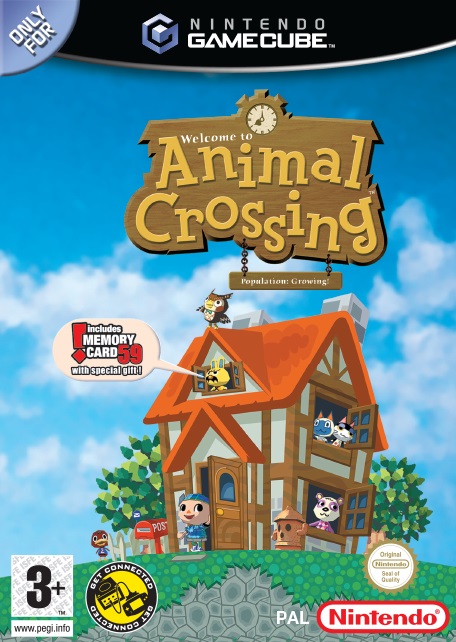



Animal Crossing — real time, small rituals, and a life lived in letters
Presentation
Animal Crossing arrived as a real‑time, open‑ended life sim where a sleepy village keeps ticking whether you play or not, keyed to the GameCube’s internal clock and calendar for seasons, holidays, and time‑specific visitors. The tone is gentle and lightly satirical—quirky animal neighbors, homes to decorate, letters to write, and a radio‑like soundtrack that changes hourly—stitched together with surprising depth, from NES game unlocks to town events, fossils, and museum collecting. Critics praised the clock/calendar design and social simulation while noting that audio/visual fidelity lagged behind GameCube showpieces; nevertheless, the vibe and novelty won out decisively.
Town life and premise
You arrive in a randomly generated village, take a no‑interest mortgage from Tom Nook, and settle into daily rhythms: errands for neighbors, fishing, bug catching, gardening, turnip trading, and seasonal festivals that encourage routine and curiosity. The village evolves with you—residents move in or out, remember interactions, and share gossip—while optional connectivity lets you visit friends’ towns, trade items, and even transfer certain NES games to a linked GBA for portable play sessions. The lack of a fixed ending reframes “progress” as home expansion, collection completion, and social bonds, turning weeks of short sessions into a personal town chronicle.
Systems and structure
-
Real‑time simulation. Events, store hours, weather, and special characters align to real‑world dates; missing a day means you simply return to a village that has changed without you, for better or worse.
-
Collect, curate, connect. Museum completion, furniture sets, clothing designs, and NES unlocks create long‑tail goals, while the letter system and villager tasks supply personality and micro‑stories.
-
Connectivity extras. GBA link cable and e‑Reader support enable scanning cards for items and transferring certain NES titles, expanding the toy‑box beyond the base disc’s content.
Length and multiplayer
There is no traditional “completion,” but most players engage for dozens of hours across months, with longevity driven by catalog goals, holidays, and social exchanges; the design expects long gaps and cozy returns. Multiplayer is asynchronous/local: up to four player profiles can share a town on one memory card, and you can travel to friends’ towns by swapping memory cards on the same console; there is no online play, and simultaneous co‑op wasn’t part of the 2002 release. GBA and e‑Reader connectivity provide additional social and collectible layers rather than real‑time co‑op.
Reception and critique
Reception at launch was broadly enthusiastic, centering on the innovative clock‑based design, emergent social texture, and the charm of collecting and decorating, while critiques flagged modest graphics and repetitive audio loops over long sessions. Awards and rankings placed it among GameCube’s best, and its sales trajectory established the series as a Nintendo pillar that would later explode globally with handheld and Switch entries. Retrospectives underline its influence on cozy games and scheduled, event‑driven design, from daily quests to seasonal content cadences across genres.
Critics’ scores
-
Metacritic — 87/100, “generally favorable,” based on dozens of critic reviews.
-
IGN — 9.1/10, praising the concept’s hook and real‑time design despite audiovisual shortcomings.
-
GameSpot — 8.1/10, highlighting the clock/calendar and social depth.
-
GamePro — 4.5/5, strong endorsement of the sim‑toy blend.
-
GameSpy — 4/5, applauding personality and routine‑driven goals.
-
Nintendo Power — multiple features and high marks across issues as content rolled out.
-
MobyGames collated reviews — roughly mid‑80s average across tracked outlets.