
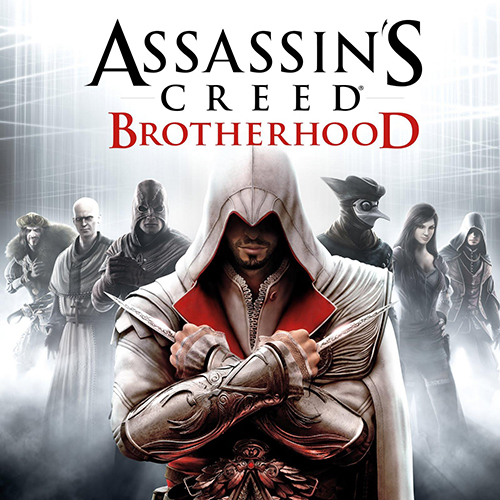



Assassin’s Creed: Brotherhood — focused Rome sandbox, systemic assassination, and a pivotal evolution of the Ezio trilogy
Presentation
Brotherhood positions itself as a “2.5” sequel: it reuses Ezio and much of AC II’s foundation, but concentrates the experience in a single, dense city—Rome—rather than a tour of Italian hubs. The shift to one large urban space supports stronger visual identity (districts, landmarks, ruins) and more seamless side content, while cutscenes, mocap, and audio maintain the high production values that defined AC II’s leap over the first game.
Story
The narrative resumes immediately after AC II: Ezio leaves the Vatican vault, returns to Monteriggioni with the Apple, and believes his vendetta against Rodrigo Borgia complete. Cesare Borgia’s New Year’s Day assault destroys Monteriggioni, kills Mario, and steals the Apple, forcing a wounded Ezio to relocate to Rome, where he discovers both the city and the Assassin Order are in disarray under Borgia control. Over several years, Ezio undermines Cesare’s political, military, and financial supports, rebuilds the Brotherhood, and ultimately brings Cesare down, ascending to the role of Il Mentore and de facto leader of the Italian Assassins while Desmond’s present‑day thread pushes the First Civilization meta‑plot forward.
Systems and structure
Brotherhood’s structure is about layering systems onto one city rather than expanding the map:
-
Rome as a systemic hub. The city is divided into Borgia‑controlled districts; dismantling Borgia towers reduces enemy presence and unlocks shops, landmarks, and renovation opportunities in a loop that ties open‑world cleaning, economic progression, and narrative control together.
-
Brotherhood system. Ezio can recruit citizens saved from guards into the order, then train and deploy them via contracts across Europe or call them in‑mission for contextual assists and the “arrow storm” mass kill, adding a light squad‑management layer on top of the classic solo assassin fantasy.
-
Combat and stealth refinements. The kill‑streak system lets Ezio chain executions after a successful finisher, smoothing AC II’s slower combat while still demanding timing and target prioritization; parkour and social stealth remain core, with some mission types demanding full synchronization (optional constraints) to encourage cleaner, more varied play.
-
Side content integration. Lairs of Romulus (parkour/combat mini‑dungeons), guild challenges, landmark objectives, and economic upgrades are more systematically woven into Rome than AC II’s sometimes siloed side missions, increasing meaningful density.
-
Multiplayer layer. The franchise’s first competitive multiplayer mode adds templar trainees hunting each other under disguise and crowd‑blending rules—while mechanically distinct from single‑player, it leverages core AC verbs (social stealth, silhouettes, line‑of‑sight) in a way that extends engagement beyond the campaign.
Length and co‑op/multiplayer
Ubisoft stated at launch that the main story clocks in at roughly 15 hours, which aligns with community and data‑driven estimates for a largely critical‑path run. Including a portion of side content—Borgia towers, some Lairs of Romulus, a subset of contracts—typical playthroughs land in the 25–30 hour range, while 100% runs (full synchronization, collectibles, maxed Brotherhood) are commonly reported around 35–42 hours. The single‑player campaign has no co‑op; multiplayer is competitive, mode‑based, and separate from the story, with progression via abilities and cosmetic unlocks rather than shared PvE content.
Critics’ scores
-
Metacritic — ~90/100 across PS3 and Xbox 360, ~88/100 on PC; “generally favorable” bordering on “universal acclaim,” often ranked among the stronger entries in the series.
-
IGN — ~9/10; praises Brotherhood’s systems and Rome’s density, calling it more than just an expansion to AC II.
-
GameSpot — ~8.5–9/10 range; highlights improved mission variety and Brotherhood mechanics, while noting some structural similarity and a story that feels like a middle chapter.
-
Eurogamer — 10/10; commends the maturity of the story and the way Rome’s missions and collectibles feel cohesive rather than checklist‑driven.
-
Game Informer — high‑80s/low‑90s (reported in round‑ups); strong endorsement of refinements and multiplayer innovation.
-
Edge — solidly positive (upper‑range) with praise for design iteration and criticism mainly of franchise fatigue risk.
-
MobyGames critic average — low‑90s across dozens of reviews, mirroring major aggregator results.
-
User sentiment (Metacritic, Reddit, GameFAQs) — commonly 8–9/10; players credit Brotherhood with polishing AC II’s formula and love the Brotherhood mechanic and Rome, while recurring complaints target some repetitive side missions, occasionally finicky full‑sync conditions, and the broader modern‑day plot’s baggage.